 |
| happy birthday to my Texan honcho in SF! |

Saturday, October 4, 2014
Wednesday, October 1, 2014
My Cousin: The Hinge-Back Tortoise

The Hinge-back Tortoises, as they are commonly called, develop a hinge that allows them to close the rear of their carapace, protecting their back legs.
Hinge-back tortoises appear to be typical tortoises on first inspection but Hinge-backs are considerably longer than they are wide, more closely resembling a Red-footed Tortoise than a Leopard Tortoise, for example. In overall size this species are on the smaller end of the tortoise range.
Hinge-backs possess the elephantine feet associated with tortoises, although the front feet are not quite as blunt as the rear. Their forelegs usually have a series of enlarged, downward-pointing scales while the rear legs lack these scales. In these chelonians the head is only of medium size, while their tail ends in a nail-like spike. Of course, the Hinge-back's distinguishing characteristic is the unique hinge that develops in adults at the rear of the carapace, between the seventh and eighth marginal scutes.
 |
| Hinge-Back Tortoise enjoying a salad! |
The carapacial hinges allow the tortoises to clamp down the rear of their carapaces, giving increased protection to their tail and legs. Hinge-backs also have effective defenses for their front legs and head. When threatened, a tortoise can retract its head quite far. Its front legs then seal the anterior opening in the carapace; the knees meet in front of the head with the feet pointing to either side. The enlarged scales on the forelegs face outward in this position, protecting the legs themselves and effectively closing the tortoise off from the world.
The Hinge-backs inhabit a diverse array of habitats in central and southern Africa, primarily in grassland and savannah regions, although some individuals can be found in coastal forests. These regions often go through times of drought, and Bell's Hinge-back burrow underground to survive these periods. This tortoise has large anal sacs which can be filled with water, taking up a large percentage of the abdominal cavity, to help it during the dry season. This stored water may be used by females when building nests to help loosen and moisten the soil in and around the nest.
Hinge-backs are omnivorous feeders in the wild. In addition to greens, they consume snails, insects such as millipedes and beetles, and will scavenge corpses when encountered. In captivity they will eat a wide variety of vegetable matter, including green beans, broccoli, squash, mushrooms, and bananas. They readily take mealworms and mealworm beetles, cooked chicken, and liver. Earthworms are relished; they are grabbed, whipped from side to side, and swallowed rapidly.
Friday, September 26, 2014

Tuesday, September 23, 2014

Saturday, September 20, 2014

Wednesday, September 17, 2014

Thursday, September 11, 2014

Tuesday, September 9, 2014
Spot!
Diamondback Terrapins with spotted legs are gorgeous - even sexy!
 |
| Learn how to help save these endangered species at the Turtle Survival Alliance |
Saturday, September 6, 2014
My Cousin: The Beale's Eyed Turtle

The Beale's Eye grows up to around 6 inches in length and in the wild, they feed upon carrion, snails, beetle larvae, earthworms, water plants and fruits. They can be found in woodland streams and brooks in southern China from Fujian to eastern Guangdong Province.
 This species is listed as endangered by the IUCN, since these turtles are hunted for use in folk medicine.
Friday, September 5, 2014

Wednesday, September 3, 2014
Sunday, August 31, 2014
Hawksbill Harry Says Hello
Hawksbill turtles have been hunted extensively for their shells which make attractive tortoise-shell jewellery, brushes, eyeglass frames and rings. In some parts of the world such as China and Japan, the hawksbill turtle is also eaten as a delicacy. So badly decimated are the hawksbills that these turtles are listed as critically endangered on the IUCN Red List.

Friday, August 29, 2014
Don't Try This at Home
... or anywhere, for that matter...
 |
| (not sure what is going on in the rear portion...) |
Tuesday, August 26, 2014
Loggerheads Come Ashore
Watch as thousands of loggerhead turtles make their way to the beaches to nest in Oaxaca, Baja California. You can learn more about loggerhead sea turtles at Turtle Time, Inc.
Saturday, August 23, 2014


Thursday, August 21, 2014

Monday, August 18, 2014

Friday, August 15, 2014

Wednesday, August 13, 2014
Sunday, August 10, 2014

Thursday, August 7, 2014

Monday, August 4, 2014

Friday, August 1, 2014

Tuesday, July 29, 2014
Monday, July 28, 2014
Hatchlings Escape Florida Keys, Make Run For It!
Live-streaming webcam catches loggerhead sea turtle hatchlings emerge from their nest in the Florida Keys!
Wednesday, July 23, 2014

Sunday, July 20, 2014

Friday, July 18, 2014

Thursday, July 17, 2014

Wednesday, July 16, 2014
Summer Mutant Ninja Turtle Turtle Movie Alert!
This important Movie Alert is being re-posted from Tortoise.com:

Dear Parents:
We're asking you to save a turtle's life and perhaps even your child's. In August, your children will be enjoying another edition of the extremely popular Teenage Mutant Ninja Turtles movie. This will include a whole new generation of kids who missed the 2007 animated film. It's fun and great entertainment.
But, we are writing this to ask for your help. Since the first movie was released in 1990, hundreds of thousands of live turtles, mostly water turtles called red eared sliders, were purchased for between $10 and $25 after each ninja movie was released. The result? Many, if not most, were dumped and even deliberately killed or flushed down the toilet. Remember people buying thousands of dogs that ended up in shelters after 101 Dalmatians came me out? Same problem.
Unfortunately, children do not realize that real turtles do not fly, perform stunts or do any of the exciting moves fictional movie turtles do. Parents, trying to please their children, purchased live turtles which ended up languishing in tanks. Or, when the kids realized after a few weeks that these were not ninja turtles, the turtles were dumped illegally into rivers and lakes as well as dumpsters, flushed down toilets or relinquished to shelters and overcrowded rescues. It's estimated that 90 percent died. As an aside, zoos do not take turtles.
 Turtles have been around for 200 million years and outlived the dinosaur. Is this the way we want to treat our precious wildlife? Most of these turtles are taken out of the wild and sold to pet stores, breeders and mercados for profit.
Here's the bigger problem. Turtles carry salmonella which can make a child very, very sick and can even kill them. That's why turtles less than four inches were banned from sale in the U.S. in 1974 and still are...tiny turtles easily fit into a child's mouth. Children also tend to touch the water and don't wash their hands. It's an ugly problem. A nine month old baby in Los Angeles got salmonella meningitis from a turtle after its parents touched it and then held the baby. We do not recommend live turtles or tortoises for children under 13 because of salmonella exposure and because the kids lose interest almost immediately.
What can you do to help? Buy Ninja action figures and toys instead of live turtles and save a turtle's life, and perhaps even your child's.
Thank you. (Please spread the word and forward this email.)
Susan Tellem and Marshall Thompson, Co-founders
American Tortoise Rescue
www.tortoise.com
Dear Parents:
We're asking you to save a turtle's life and perhaps even your child's. In August, your children will be enjoying another edition of the extremely popular Teenage Mutant Ninja Turtles movie. This will include a whole new generation of kids who missed the 2007 animated film. It's fun and great entertainment.
But, we are writing this to ask for your help. Since the first movie was released in 1990, hundreds of thousands of live turtles, mostly water turtles called red eared sliders, were purchased for between $10 and $25 after each ninja movie was released. The result? Many, if not most, were dumped and even deliberately killed or flushed down the toilet. Remember people buying thousands of dogs that ended up in shelters after 101 Dalmatians came me out? Same problem.
Unfortunately, children do not realize that real turtles do not fly, perform stunts or do any of the exciting moves fictional movie turtles do. Parents, trying to please their children, purchased live turtles which ended up languishing in tanks. Or, when the kids realized after a few weeks that these were not ninja turtles, the turtles were dumped illegally into rivers and lakes as well as dumpsters, flushed down toilets or relinquished to shelters and overcrowded rescues. It's estimated that 90 percent died. As an aside, zoos do not take turtles.
Here's the bigger problem. Turtles carry salmonella which can make a child very, very sick and can even kill them. That's why turtles less than four inches were banned from sale in the U.S. in 1974 and still are...tiny turtles easily fit into a child's mouth. Children also tend to touch the water and don't wash their hands. It's an ugly problem. A nine month old baby in Los Angeles got salmonella meningitis from a turtle after its parents touched it and then held the baby. We do not recommend live turtles or tortoises for children under 13 because of salmonella exposure and because the kids lose interest almost immediately.
What can you do to help? Buy Ninja action figures and toys instead of live turtles and save a turtle's life, and perhaps even your child's.
Thank you. (Please spread the word and forward this email.)
Susan Tellem and Marshall Thompson, Co-founders
American Tortoise Rescue
www.tortoise.com
Monday, July 14, 2014
Siebenrock’s Snake-necked Turtle
Before you say "ew," learn about this snakey carnivorous turtle who can shoot water from his nose!

Learn more about the Snake Necked Turtle and all his friends at the Reptile & Amphibian Discovery Zoo. Just click here.
Learn more about the Snake Necked Turtle and all his friends at the Reptile & Amphibian Discovery Zoo. Just click here.
Saturday, July 12, 2014
Thursday, July 10, 2014

Monday, July 7, 2014

Friday, July 4, 2014
Tuesday, July 1, 2014

Sunday, June 29, 2014

Wednesday, June 25, 2014
Which Came First?
The turtle or the egg?
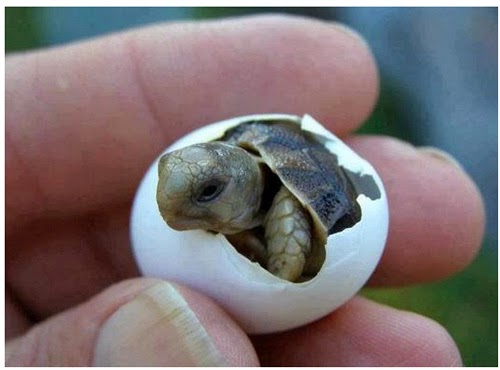 |
| don't have all the answers, but this little guy sure is cute! |
Saturday, June 21, 2014

Wednesday, June 18, 2014
Sunday, June 15, 2014

Wednesday, June 11, 2014
R.I.P "Hole"

(Courtesy of American Tortoise Rescue)
Hole was named after a prominent hole someone cruelty drilled in the front of his shell to tether him years ago. He arrived at American Tortoise Rescue 20 plus years ago after being caught in the wild near his gulf coast home and shipped to a pet store in Los Angeles. I received a call from the pet store manager asking me if I would come in and look at one of the turtles who had been pretty much unresponsive all week - not eating or moving.
From the beginning, it was touch and go, but he made it and became one of the rescue's favorites. He lived outside year round always showing up for worms and loving his soaks in a plant saucer. His eyes were bright red with some white around the edges telling us that he was old. (Red eyes turn whiter as they age.) He was always a bright spot in our daily routine and was never a problem. During the more than 20 years we had Hole, his eyes turned completely white from red. We guessed his age at around 50 years or more.
Sadly many of these wild caught turtles and tortoises die from stress or shortly afterwards en route to pet stores or breeders or even well meaning people who don't know buying turtles and tortoises is a bad thing.
You can make a tax deductible donation in Hole's memory by sending a check to American Tortoise Rescue, 30745 PCH, #243, Malibu CA 90265. All monies go directly to the housing, feeding and medical care of turtles and tortoises.
(TAX I.D. # 93-1219374)
Friday, June 6, 2014
Caught on Camera
Late night clandestine meeting with my mate seemingly caught on surveillance camera.

Sunday, June 1, 2014

Monday, May 26, 2014
Thursday, May 22, 2014

Monday, May 19, 2014

Thursday, May 15, 2014

Sunday, May 11, 2014

Saturday, May 3, 2014

Tuesday, April 29, 2014

Saturday, April 26, 2014

Tuesday, April 22, 2014

Sunday, April 20, 2014

Subscribe to:
Posts (Atom)